Key Takeaway
THHN vs THWN vs THWN-2 for buyers: dry, damp or wet ratings, 75°C vs 90°C, dual marking and what to confirm in your RFQ before you order.
Neither THHN nor THWN is the "better" wire. The right choice depends on whether the run is dry, damp or wet, the conductor temperature the design assumes, and what the project's electrical code and engineer will accept. If any part of the run can get wet, do not order on the word "THHN" alone: specify THWN or THWN-2 and ask to see that marking printed on the wire.
Most confusion comes from dual-marked wire. A lot of stock is printed "THHN/THWN" or "THHN/THWN-2", so buyers start treating the names as interchangeable. They are not. A dual marking is a property of a specific product that the manufacturer has to prove. It is not a default you can assume from a quotation.
This guide is written for importers, distributors, EPC buyers and contractors in the Philippines, Southeast Asia, Africa, the Middle East and South Asia who have to buy North American wire types against a project specification. It covers what each type actually means for procurement, four common project scenarios, a copy-ready RFQ template, and how to check a quotation before you commit.
Quick Decision Table: Which Type to Specify
| Installation | What the buyer should focus on | What the RFQ must confirm |
|---|---|---|
| Dry indoor conduit (offices, retail, above-grade commercial fit-out) | THHN is usually acceptable where the code treats the location as dry or damp. Main choices are conductor size, solid vs stranded, colour coding and reel length. | Applicable code and edition, "THHN" or dual marking required, AWG/kcmil size, solid or stranded, colours, packaging |
| Damp or possibly wet conduit (underground runs, slabs on grade, outdoor raceways, basements, pump rooms) | The wire needs a wet-location marking. THWN is rated 75°C wet; THWN-2 is rated 90°C wet. THHN alone is not a wet-location type. | "THWN-2" (or "THWN") printed on the wire, which ampacity column the design uses, proof of the marking on the datasheet and sample |
| Distribution boards and control panels | Termination temperature, stranding for bending, and whether the panel builder follows a different equipment standard | Stranded class, colours per phase, termination rating of the equipment, whether the panel standard even calls for THHN |
| One project with mixed environments | One dual-marked product can simplify stock, but only if the exact marking covers every location | One line item per required marking, or one THHN/THWN-2 product with the dual marking confirmed in writing and on the sample |
The rest of this article explains how to use this table, and where a supplier should never fill in the blanks for you.
What THHN, THWN and THWN-2 Mean for Procurement
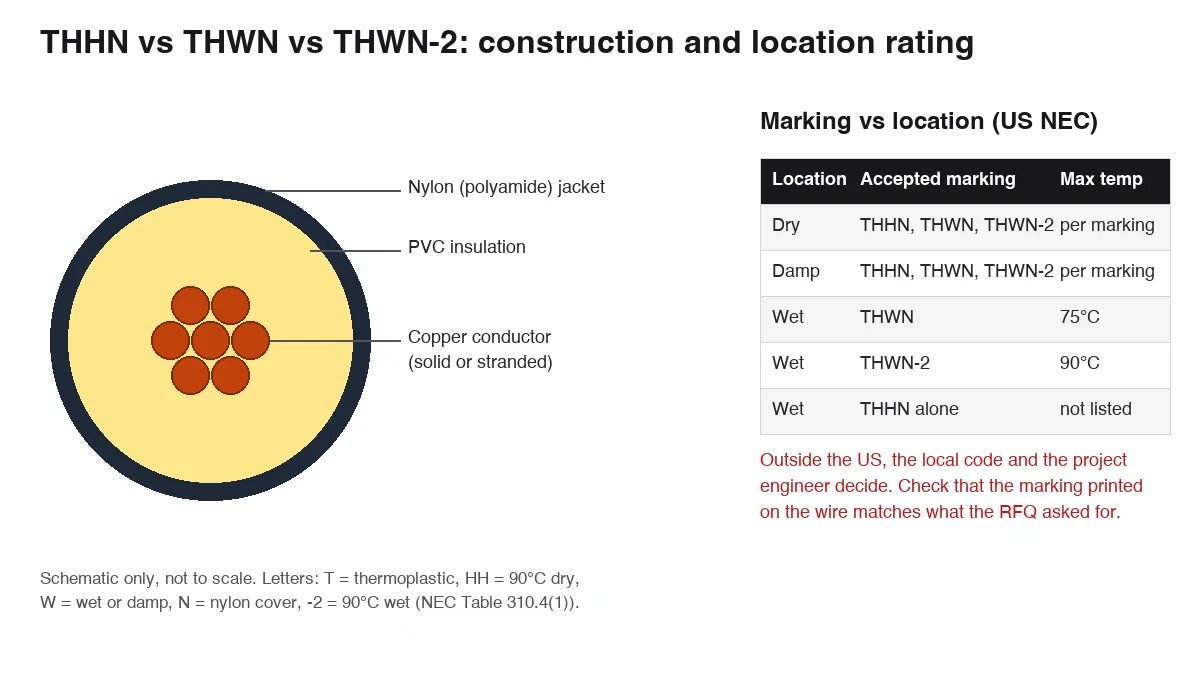
The letters come from the US National Electrical Code (NFPA 70). In recent editions they are listed in Table 310.4(1), "Conductor Applications and Insulations". The letters decode as follows:
- T: thermoplastic insulation
- HH: 90°C rating in dry locations
- W: permitted in wet or damp locations
- N: nylon outer cover
- -2: 90°C rating in wet locations
For the three types in this guide, Table 310.4(1) of the NEC gives:
| Type | Insulation | Max. operating temperature | Locations | Outer cover | Size range in the NEC table |
|---|---|---|---|---|---|
| THHN | Flame-retardant, heat-resistant thermoplastic | 90°C | Dry and damp | Nylon jacket or equivalent | 14 AWG to 1000 kcmil |
| THWN | Flame-retardant, moisture- and heat-resistant thermoplastic | 75°C | Dry, damp and wet | Nylon jacket or equivalent | 14 AWG to 1000 kcmil |
| THWN-2 | Flame-retardant, moisture- and heat-resistant thermoplastic | 90°C | Dry, damp and wet | Nylon jacket or equivalent | 14 AWG to 1000 kcmil |
Source: NFPA 70, Table 310.4(1). The same temperature split shows up in the ampacity table: in the NFPA 2025 Motions Committee report, Table 310.16 refers back to Table 310.4(1) and places THWN in the 75°C column and THHN and THWN-2 in the 90°C column. Always check the edition your project has adopted.
The practical differences, one by one
Location. This is the difference that matters most. Under the NEC, THHN is for dry and damp locations only. THWN and THWN-2 are also permitted in wet locations. If a conduit can take on water, the insulation must carry a W marking.
Temperature. THHN and THWN-2 are 90°C types. THWN is 75°C. That rating feeds into ampacity. A higher conductor temperature lets the designer use a higher ampacity column, as long as the terminations and the rest of the system allow it. If the engineer sized a wet-location feeder on the 90°C column, THWN is not a like-for-like substitute. THWN-2 would be.
Construction. All three are thermoplastic insulation (PVC in practice) with a nylon or equivalent cover. The Huanghe product line is built the same way: copper conductor, PVC insulation, nylon jacket. Because the construction looks identical, you cannot tell THHN from THWN-2 by looking at a cut end. The difference is proven by testing and shown by the print legend.
Single or dual marking. Many manufacturers design one compound system that passes both sets of requirements and print both names on the wire, for example "THHN/THWN-2". Each marking keeps its own rating. Wire marked THHN/THWN can be used at the THHN 90°C rating in a dry location, but in a wet location only the THWN 75°C rating applies. A dual marking gives flexibility only when it is really on the wire.
Project acceptance. A type letter is only useful if the governing code recognises it. In the US, conductors installed under the NEC are normally expected to be listed products, so check the listing requirement in the edition your project uses. Outside the US, whether the project needs a listing, a national product certificate, a type test report or just a manufacturer's declaration is set by the local regulator and the project documents, not by the letters on the wire.
Why the NEC is a reference, not a global rule
THHN and THWN are North American designations. The product standard behind them is UL 83 Thermoplastic-Insulated Wires and Cables. UL's own wire and cable scope table lists the thermoplastic-insulated wire category (ZLGR) against UL 83 and UL 83A. That is a North American listing framework. It does not govern installations anywhere else.
Many target markets still use these wire types, but on their own terms:
- Philippines. According to the DTI-BPS profile of Technical Committee 77, the Philippine Electrical Code was developed based on the US NEC. That does not make every PEC clause identical to a given NEC edition, but it explains why THHN/THWN demand is strong there. The DTI Bureau of Philippine Standards (BPS) lists thermoplastic-insulated electric wires and cables as a product under mandatory certification. The current reference standard, PNS 35:2021 Thermoplastic-insulated copper wires and cables rated 600V, covers 600 V building wire including THHN, THWN and THWN-2, and this scope has been under mandatory certification since 4 July 2023 (DAO 22-07:2022). Covered products must carry a PS mark or ICC sticker before distribution. These are two separate routes: the PS mark is a quality certification mark licence held for a manufacturer's product, and the ICC is an import commodity clearance for imported wire. Before entering the Philippine market, check with BPS which route applies to your product and shipment under the current rules.
- Other Southeast Asian, Middle Eastern, African and South Asian markets. Many projects run on IEC-based wiring rules and specify IEC 60227 or IEC 60502 type cables in mm². THHN/THWN turns up where a US-based consultant, an American equipment package or a local NEC-derived code is involved. In those cases the specification, not habit, decides the type.
The safe position for a buyer is simple. Treat the NEC tables as the definition of what THHN, THWN and THWN-2 mean. Treat your project's adopted code, the engineer's specification and the local certification regime as the rules for what you can install.
Four Project Scenarios
Each scenario below splits the decision into what the buyer can confirm, what must go to the engineer, how to write it in the RFQ, and what the supplier must not assume.
1. Commercial building, indoor conduit
Typical case: branch circuits and small feeders in EMT or PVC conduit above ceilings and inside walls of an office tower, mall or hotel.
The buyer confirms: conductor sizes from the cable schedule, solid or stranded for each size, colour coding for phases, neutral and ground, reel or coil lengths that suit the pull lengths on site, and total quantity per size.
The engineer confirms: that every run on the schedule is a dry or damp location under the adopted code. Some locations that look indoor may still count as wet under the code, for example conduit that runs through an outdoor section or below grade before entering the building. Ask the engineer to mark where the dry/wet boundary sits on this project, instead of inferring it from the architectural drawings.
RFQ wording: "Single-conductor copper building wire, type THHN (or THHN/THWN-2 dual marked, if offered), 600 V, sizes and quantities per attached schedule, solid 14–10 AWG and stranded 8 AWG and above, colour-coded per schedule. State the exact print legend."
The supplier must not assume: that THHN is fine because the drawings say "indoor", that any stranding class is acceptable, or that the buyer's colour code follows US practice.
2. Damp or possibly wet conduit
Typical case: underground conduit from a transformer or generator to the main switchboard, conduit in a slab on grade, rooftop and outdoor raceways, car-park ramps, pump rooms and basements.
The buyer confirms: the list of runs that are, or could become, wet, and whether the site team wants one product for all of them to simplify stock.
The engineer confirms: the ampacity basis. If the design used the 90°C column for a wet run, specify THWN-2. If it used the 75°C column, THWN is acceptable, but THWN-2 is often ordered anyway to avoid a second item. The engineer also confirms that a conductor in conduit is really the right system here, and not direct-burial cable. Under the NEC, conductors exposed to direct sunlight must be listed or marked sunlight resistant, or covered with a listed or marked sunlight-resistant material. Direct burial is a separate question for the engineer. A plain THHN or THWN marking does not answer either one, so check before substituting.
RFQ wording: "Single-conductor copper building wire, type THWN-2 (THHN/THWN-2 dual marking acceptable), 600 V, wet-location rated at 90°C. The wet-location type designation must be printed on the insulation. Provide the datasheet and a photo of the print legend for each size quoted."
The supplier must not assume: that "THHN" in the buyer's first email means the buyer accepts a dry-only product, or that a THWN (75°C) offer is equivalent to a THWN-2 request.
3. Distribution boards and control panels
Typical case: internal wiring of low-voltage switchboards, motor control centres and control panels, assembled locally or by a panel builder.
The buyer confirms: who is building the panel and which standard they build to. A builder working to a North American panel specification may ask for THHN-type wire. A builder working to IEC 61439 will often expect IEC-type flexible wire in mm², and THHN may not be what they want at all. Ask before you order.
The engineer or panel builder confirms: conductor class and flexibility, the temperature rating of terminals and devices, and whether the wire has to follow a specific colour scheme.
RFQ wording: "Stranded copper panel wire, type THHN/THWN-2 (or as specified by the panel standard), sizes per panel schedule, colours per phase. State stranding and conductor class."
The supplier must not assume: that building wire and panel wire are the same product, or that the panel builder accepts AWG sizes when the rest of the drawings use mm².
4. Hot, humid Southeast Asian projects
Typical case: a resort, hospital, factory or data centre in a coastal or monsoon climate, with long outdoor conduit runs and plant rooms exposed to condensation.
The buyer confirms: the ambient temperatures in the design basis, the parts of the route exposed to rain, flooding or condensation, and whether local distributors already stock a particular marking.
The engineer confirms: ambient temperature correction and conduit fill derating under the adopted code, and whether conduit interiors on this site should be treated as wet by default. If the engineer decides to treat conduit interiors as wet across the site, specify a wet-location type throughout rather than trying to split dry and wet runs on site.
RFQ wording: "Single-conductor copper building wire, type THHN/THWN-2 dual marked, 600 V, 90°C dry and wet. Conductors to be suitable for the design ambient in the attached basis of design. Confirm the print legend and state which test records are available for each size."
The supplier must not assume: the ambient temperature, the local code edition, or that a humid site only has dry locations because the drawings do not say otherwise.
Copy-Ready RFQ Template
Most quotation problems start with a vague first email. "Please quote THHN 12 AWG, 50 rolls" leaves out the code, the location, the stranding, the marking and the documents, so every supplier fills in the gaps differently and the offers cannot be compared. Paste the template below into your RFQ and fill in every line. If you don't know a line, mark it "to be confirmed by engineer" so the supplier cannot quietly pick an answer for you.
RFQ: Single-conductor building wire (THHN / THWN / THWN-2)

1. Governing code and edition:     e.g. Philippine Electrical Code Part 1 (state edition) / NEC 2023 / project spec section ___
2. Product standard required:       e.g. UL 83, or "manufacturer to state"
3. Project country / destination:   ___  (port of discharge: ___)
4. Installation environment:        conduit / trunking / panel / cable tray / other: ___
5. Location classification:         dry / damp / wet  (per engineer; attach run list if mixed)
6. Required type marking:           THHN / THWN / THWN-2 / THHN/THWN-2 dual
7. Conductor temperature basis:     75 degC / 90 degC  (per ampacity calculation)
8. Conductor material:              annealed copper (state if tinned or aluminium is required)
9. Conductor construction:          solid / stranded; stranding class if specified
10. Size per line item:             AWG or kcmil (state mm2 only if the spec is metric)
11. Voltage rating:                 e.g. 600 V, as required by the specification
12. Insulation and jacket:          PVC insulation with nylon jacket; any extra ratings required
                                    (e.g. oil/gasoline resistant, sunlight resistant) must be listed here
13. Colours:                        per line item (phase / neutral / ground scheme)
14. Print legend:                   required text, e.g. manufacturer, type, size, voltage, temp,
                                    standard, lot/date code, sequential length marking if needed
15. Packaging:                      coil / reel; length per coil or reel; reel type; carton or pallet
16. Quantity:                       per size and colour, in metres or feet (state which)
17. Documents with quotation:       datasheet per size; photo of the print legend
18. Documents with shipment:        supplier to state which are available for this build
                                    (routine / factory test records, certificate of conformity)
19. Third-party certification:      required? which body / mark? (e.g. PS/ICC for the Philippines)
                                    If yes, supplier to state certificate number and covered models/sizes
20. Inspection:                     pre-shipment inspection by buyer or third party? witness tests?
Three lines deserve extra attention:
- Line 6 (required type marking). Write the exact letters you need, including "-2" if the design uses 90°C in wet locations. "THHN/THWN" and "THHN/THWN-2" are different products.
- Line 10 (size). AWG sizes do not match metric sizes one-for-one. 12 AWG is about 3.31 mm² and 14 AWG is about 2.08 mm², so neither is the same as a 4 mm² or 2.5 mm² conductor. If the drawings are in mm² and you want THHN, the engineer has to confirm the AWG equivalent. See our mm² to AWG cable size chart for the conversion table.
- Line 19 (certification). Say whether a certificate is mandatory, and for which mark. "Built to UL 83" and "UL Listed" are not the same statement (see below).
How to Check a Quotation Before You Order
Once offers come back, check each one against the RFQ, not against the other offers. A cheaper price often means a different product.
1. Name and parameters must agree. If the quotation header says THWN-2 but the datasheet shows only a 75°C wet rating, one of them is wrong. Ask which one is correct before comparing prices.
2. Ask for the print legend. The marking on the insulation is what the inspector will read on site. Ask for a photo of the printed legend on the actual size quoted, or for the legend text as it will appear. It should show the type (for example "THHN/THWN-2"), size, voltage and temperature, plus anything else your specification requires.
3. Read the datasheet per size, not per family. Dual markings, stranding and some special ratings are sometimes only offered on part of the size range. Check that every size on your schedule is covered by the data given.
4. Watch for THHN / THWN / THWN-2 slippage. Common patterns include a THWN-2 request answered with "THHN/THWN", a THHN offer for runs you listed as wet, or a price for "THW" (no nylon jacket) presented as equivalent. Any of these can be fine if the engineer accepts it. None of them is the product you asked for.
5. Certificates must cover the exact product. A certificate has a scope: specific models, sizes, voltages and sometimes factory locations. An ISO 9001 certificate covers the management system and does not certify a product. A CCC or CB certificate for IEC-type BV wire does not cover THHN. If your project needs a certificate, check that its scope names the wire type and size range you are buying. For more on reading scope, see our cable certification guide.
6. Factory test documents. Ask which routine tests are done on your production run and which records the supplier can actually provide for this build. Typical items are conductor resistance, dimensions (insulation and jacket thickness), spark or voltage test, and marking inspection. The exact test list depends on the standard named on the order. Get the list of documents in writing before you place the order, rather than assuming a report will arrive with the goods.
Common Buying Mistakes
Buying on the name alone. "THHN" is used loosely in some markets as a generic word for nylon-jacketed building wire. On a purchase order it should mean exactly one thing. If the site has wet runs, a dry-rated product that only says THHN is a non-conformance, however cheap it was.
Assuming every THHN is dual marked. Much stock in some markets is dual marked, so buyers stop asking. A factory building to your order will print what the order specifies. If you need "THHN/THWN-2", write it down and check the sample.
Confusing "made to the standard" with "certified". A factory can build and test wire to the requirements of UL 83 without holding a UL listing for that product. US projects under the NEC normally expect listed conductors. Whether your project needs a listing, a national mark such as PS/ICC, or only a test report is a question for the regulator and the engineer. The supplier's wording has to match what it can actually document.
Not specifying solid or stranded. Small sizes are commonly available both ways. Solid and stranded conductors handle and terminate differently. The choice should match the terminal type, the pulling route, the conductor construction named in the specification and the applicable standard. If you don't say, you get whichever the supplier makes by default.
Treating AWG and mm² as equal. Rounding 12 AWG to "4 mm²" or 14 AWG to "2.5 mm²" changes the conductor size. It can also break the ampacity, voltage-drop and conduit-fill calculations the engineer already approved.
Leaving out the country and code. The same wire can be acceptable on one project and rejected on another because of the adopted code, the certification regime or the consultant's specification. Put the country, code and edition at the top of the RFQ.
What Huanghe Can Supply, and What We Don't Claim
This section covers only what our current product data supports.
What the product line includes. Our THHN / THWN building wire range covers THHN, THWN and THWN-2 in the same construction: copper conductor, PVC insulation and a nylon jacket. Sizes on our factory table are 14, 12 and 10 AWG solid, and 8 AWG to 4/0 AWG plus 250 to 1000 kcmil stranded. The same factory table also lists 1250 and 1500 kcmil as special large sizes. Those two sizes are outside the THHN / THWN size range in the NEC type table quoted above, so do not assume a project will accept them under the THHN designation. Ask the engineer and the authority having jurisdiction to confirm them first, and until they do, do not treat them as a substitute for standard THHN.
What we don't hold. We do not currently hold a product certificate for THHN, THWN or THWN-2. This wire is not UL Listed, and it is not covered by the CCC or CB certificates we hold. Those certificates apply to specific IEC-type models (BV and BLV) within the ranges printed on them. The details are on our certificates page. We build THHN / THWN / THWN-2 to the standard and marking written on your order. Which documents are available (datasheet, routine or factory test records, certificate of conformity, any third-party report) depends on the build, so we confirm the list with you before quotation or order.
What that means for your project. If your project only needs wire made and tested to a named standard, with the correct marking, we can confirm manufacturing feasibility and the available documents against your specification before quoting. If your project requires a listing or a national certification mark, confirm the certification route with your regulator or engineer before you order, and check any certificate's scope against the exact type and sizes you are buying. We would rather tell you at the RFQ stage that a requirement is outside our current certification than find out at customs.
You can see our production lines and test lab on the factory page.
Planning quantities and lead time
For our building wire, the working minimum is 500–1,000 metres per size for regular types and 2,000–5,000 metres per size for special or custom builds. Which band your order falls into is confirmed after we review the RFQ. The reason is set-up: each new size or construction means changing over the stranding and extrusion lines, so a special build needs a longer run to be practical. Production normally takes 10–15 days after the order details are confirmed. That does not include sea freight, and it is a planning range rather than a fixed delivery or arrival date.
For other single-core fixed wiring (BV, BYJ, BLV) and flexible, twin & earth or earth wire, see the full electrical wire range.
Send Your Specification
To check THHN / THWN / THWN-2 manufacturing and quotation feasibility, send us your RFQ with:
- The governing code or standard, and the edition
- Conductor sizes (AWG / kcmil), solid or stranded, and colours
- Installation environment and the dry / damp / wet classification of each run
- Quantity per size, plus coil or reel length
- Destination country and port
We will reply with the type marking and print legend we can produce, the datasheet for each size, the documents we can provide for that build, and any requirement on your list that our current certification does not cover.
FAQ
What is the main difference between THHN and THWN?
Under the US NEC, THHN is rated 90°C for dry and damp locations. THWN is rated 75°C and adds wet locations. Both are thermoplastic insulation with a nylon or equivalent jacket, so they look the same. The printed marking tells you which one you have.
Can I use THHN in wet locations?
Not if the wire is marked THHN only. For wet locations under the NEC, the wire must carry a wet-location marking such as THWN or THWN-2. Dual-marked THHN/THWN or THHN/THWN-2 wire can be used wet within the rating of its wet marking. Outside the US, your adopted code and engineer decide.
THWN-2 vs THHN: which should I order?
If every run is dry or damp, THHN is usually sufficient. If any run is wet and the design uses the 90°C ampacity, order THWN-2, or THHN/THWN-2 dual-marked wire, so one product covers both. Confirm the choice against the engineer's ampacity basis.
Is all THHN wire dual marked THHN/THWN-2?
No. Dual marking is common in some markets, but it belongs to a specific product that has been built and tested for both types. Put the exact marking in your RFQ and check it on the sample and the datasheet.
Is 12 AWG THHN the same as 4 mm² wire?
No. 12 AWG is about 3.31 mm². Converting between AWG and metric sizes changes the conductor, so the engineer has to approve any substitution.
Is your THHN wire UL Listed?
No. We do not currently hold a UL listing or other product certificate for THHN / THWN / THWN-2. We build to the standard and marking on your order and confirm which datasheets and test records are available before you order. If your project requires a listing or a national mark, confirm that before ordering.
Sources
- NFPA, NFPA 70, National Electrical Code, official code page. Table 310.4(1), Conductor Applications and Insulations.
- NFPA, Report of the Motions Committee for the 2025 NFPA Technical Meeting, NFPA 70 Table 310.16 (temperature columns by insulation type, cross-referenced to Table 310.4(1)).
- UL Solutions, Wire & Cable General FUII Scope Table and Addendum List, category ZLGR, UL 83 / UL 83A.
- DTI Bureau of Philippine Standards, Thermoplastic insulated electric wires and cables, PNS 35:2021 and DAO 22-07:2022.
- DTI Bureau of Philippine Standards, PS and ICC Marks.
- DTI Bureau of Philippine Standards, BPS Technical Committee Profile, First Edition, Technical Committee 77 profile: states that the Philippine Electrical Code was developed based on the US NEC.
- Huanghe Cable Group factory product data, as published on our building wire page.