Key Takeaway
Buying 33kV cable with an MDPE oversheath from a China factory: what to write into your specification, how to read the quotation and the sheath test report, thickness limits under IEC 60502-2, and how third-party inspection is arranged. For utility, EPC and contractor buyers in Africa, the Middle East and Southeast Asia.
Two suppliers quote your 33kV cable enquiry. Both write "MDPE oversheath" on the quotation. One arrives with a sheath that survives being dragged through a duct on a hot afternoon; the other arrives noticeably thinner, scuffs through to the armour on the first pull, and the drum has no metre marking to prove which section failed.
Nothing on either quotation told you this in advance. "MDPE sheath" is a material family, not a specification — and the gap between the two ends of that family is where budget cable gets built.
This guide is written for the person raising the purchase order: a utility procurement engineer, an EPC buyer, or a contractor pricing a distribution package. It covers the lines your specification has to contain before a factory can be held to anything, how to read the sheath section of a quotation and a test report, what the thickness limits under IEC 60502-2 actually permit, and how to arrange inspection before the drums ship. We extrude MDPE oversheaths on our own medium voltage cable lines, so the numbers below are the ones we are held to as well.

Why "MDPE Sheath" on a Drawing Is Not Yet a Specification
Medium-density polyethylene is defined by density, and the band is wide. In normal cable-industry usage MDPE sits between roughly 0.926 and 0.940 g/cm³ — above LDPE, below HDPE — with the density figure itself determined by test to ISO 1183. Two compounds at opposite ends of that band behave differently in the trench: the denser end is stiffer and more abrasion resistant, the lighter end is easier to pull around bends and easier to strip at joints.
That leaves three things a factory can legitimately vary while still writing "MDPE" on the drum:
- The compound. Density, carbon black content, and whether the material is virgin or partly reprocessed.
- The thickness. Nominal value, and how close to the permitted minimum the extrusion line actually runs.
- The finish. Smooth or ribbed, and whether identification is extruded into the sheath or printed on the surface.
None of those three is wrong on its own. What is wrong is a purchase order that does not say which one you are buying, because the factory will resolve every ambiguity in the direction of cost. The rest of this guide is about closing those gaps in writing before the price is agreed.
The Seven Lines Your Specification Must Contain
These lines are what make an oversheath enforceable. Anything missing here becomes the factory's choice rather than yours. Send them with the enquiry, not after the order is placed.
| # | Line to specify | What to write | Why it matters commercially |
|---|---|---|---|
| 1 | Material and sheath type | MDPE oversheath to IEC 60502-2, polyethylene sheath type ST7 | Names the sheath family in the standard's own designation instead of a marketing word |
| 2 | Density class | 0.926-0.940 g/cm³, density determined to ISO 1183 | The ST code does not fix density on its own — this line is what stops a lighter LDPE-grade compound arriving as MDPE |
| 3 | Nominal thickness | State the mm figure for each cross-section | The single biggest cost lever inside the sheath |
| 4 | Minimum acceptable thickness | No measured point below the IEC 60502-2 minimum | Converts a nominal value into a rejectable one |
| 5 | Colour and UV protection | Black, carbon black content stated | Drums often sit in the sun on site before pulling |
| 6 | Identification | Extruded marking plus sequential metre marking | Lets you trace which drum section failed |
| 7 | Test evidence | Routine test report per drum, sheath tests included | Turns the six lines above into something auditable |
Two of these deserve expanding, because they are the ones most often left out.
Line 4 is what makes line 3 real. A nominal thickness on its own is unenforceable, because extrusion always varies around the nominal value. Without a stated minimum, a factory running consistently under nominal is not technically in breach of your document. Write both numbers, every time.
Line 6 costs almost nothing and prevents the argument. Extruded marking survives being dragged through a duct; surface printing does not always. Sequential metre marking is what lets you say "the damage is at 412m on drum 3" instead of debating whether the cable or the installation was at fault. Specify it and it appears. Leave it out and it may not.
If you would rather work from a range where these lines are already fixed, our medium voltage power cable range is built to them as standard.
Reading the Quotation: What a Serious Sheath Offer Contains
Most 33kV quotations are one line per cross-section with a price against it. That format hides the sheath completely. Before comparing two prices, check that both offers state the following. If either one does not, you are not comparing the same product.
- Sheath type designation, not just the word MDPE. The type code tells you which test regime the material has to pass.
- Nominal sheath thickness in mm, per cross-section. Thickness rises with cable diameter. A single figure covering the whole schedule means nobody costed it properly.
- Overall cable diameter and drum weight. These are the cross-check on thickness. Same construction, same claimed sheath, but a noticeably smaller overall diameter means the numbers do not reconcile.
- Drum lengths, tolerance, and how partial lengths are handled. This decides how much cable you pay for versus how much you install.
- Which tests are inside the price and which are chargeable extras. Routine tests should never be an extra.
- Whether marking is extruded or printed, and whether metre marking is included.
Ask one follow-up question of any offer that looks unusually cheap: what minimum measured sheath thickness do you accept at your own outgoing inspection? A factory that has a number runs to a limit. A factory that treats the question as strange is running to whatever the line produced that shift.
On commercial terms our own position is straightforward. Production is 10-15 days. MOQ is 500-1,000 metres per specification for standard constructions and 2,000-5,000 metres per specification for custom ones - the threshold comes from stranding and extrusion changeover time rather than tonnage, which is exactly why a custom compound or a non-standard sheath colour raises it. Sea freight sits on top of production time and depends on the destination port. If your quantity is close to the threshold, say so and we will look at it rather than turning the enquiry away.
MDPE, PVC or HDPE: Deciding on Cost, Service Life or Buildability
This is a procurement decision before it is a materials decision. All three are permitted sheath materials under IEC 60502-2. They differ in what they cost you later.
| Property | MDPE | PVC | HDPE |
|---|---|---|---|
| Typical density band | 0.926-0.940 g/cm³ | Compound dependent | Above 0.940 g/cm³ |
| Water absorption | Very low | Higher than PE | Very low |
| Abrasion resistance in ducts | Good | Moderate | Best of the three |
| Flexibility for pulling and bending | Moderate | Best of the three | Stiffest |
| Low-temperature impact behaviour | Good | Weakest of the three | Good |
| Stripping at joints and terminations | Straightforward | Easiest | Hardest, jointers notice |
| Relative unit cost | Middle | Lowest | Highest |
| IEC 60502-2 sheath family | Polyethylene | PVC | Polyethylene |
How that resolves in practice:
- Direct burial and duct pulls point to MDPE. Low water absorption matters because a buried 33kV circuit sits in wet ground for decades, and a sheath that takes up moisture is the first step towards trouble in the layers underneath. Abrasion resistance matters because the sheath meets the duct wall exactly once, under tension, and that is the moment it either survives or does not.
- PVC is cheaper and stays legitimate for cable in air, on trays, or on dry indoor routes, and it strips more easily. It is the wrong economy on a long buried run in a hot or wet climate.
- HDPE beats MDPE on abrasion and is worth specifying on long duct pulls with many bends. The trade is stiffness: harder to handle on site, harder to strip, and your jointing crews will raise it even if procurement does not.
The buying rule that follows: choose the sheath from the route, not from the price column. A PVC sheath saved on a direct-burial 33kV circuit is paid back as excavation, and excavation costs more than the cable order did.
Sheath Thickness: Nominal, Minimum, and What You Measure at Inspection
Thickness is where a sheath quietly becomes cheaper, so it is the number your inspection has to be built around. Three values matter, and buyers routinely specify only the first.
- Nominal thickness (tn). The design figure, stated per cross-section in the datasheet. It rises with cable diameter, which is why a single figure across a whole schedule is a warning sign in a quotation.
- Minimum measured thickness at any point. IEC 60502-2 does not require every point to reach nominal. It sets a floor below nominal, expressed as a formula rather than a flat number, and any single measured point below that floor is a fail.
- Mean of measurements. Taken around the circumference on a sample ring, this is what shows whether the line was centred or running thin on one side.
The practical consequence for a buyer: a drum can be fully compliant with the standard and still sit consistently under the nominal figure printed in the datasheet. That is legitimate. What is not legitimate is a factory that treats the standard's floor as its production target, because then normal process variation puts part of the run below the floor.
So write the acceptance line as two conditions, not one:
- Nominal thickness per cross-section as stated in the approved datasheet.
- No individual measured point below the IEC 60502-2 minimum for that nominal value.
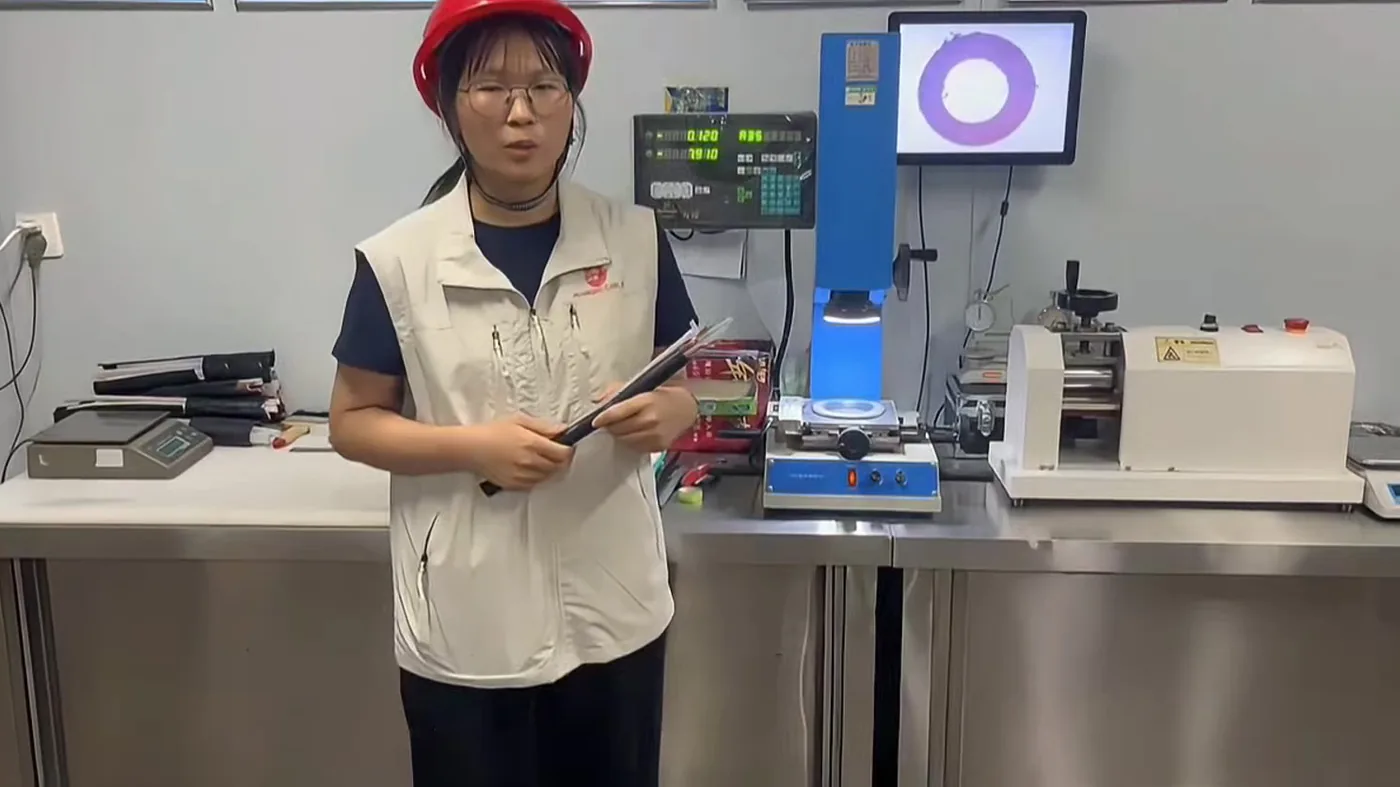
At inspection, this is measured on a ring cut from the cable end with a thickness gauge or a profile projector, taking readings at several points around the circumference. It takes a few minutes per drum and it is the single most useful physical check available to a buyer who cannot audit the extrusion line itself. Ask for the readings to be recorded per drum rather than as one figure for the batch.
Where the Oversheath Sits, and the Four Layers to Confirm With It
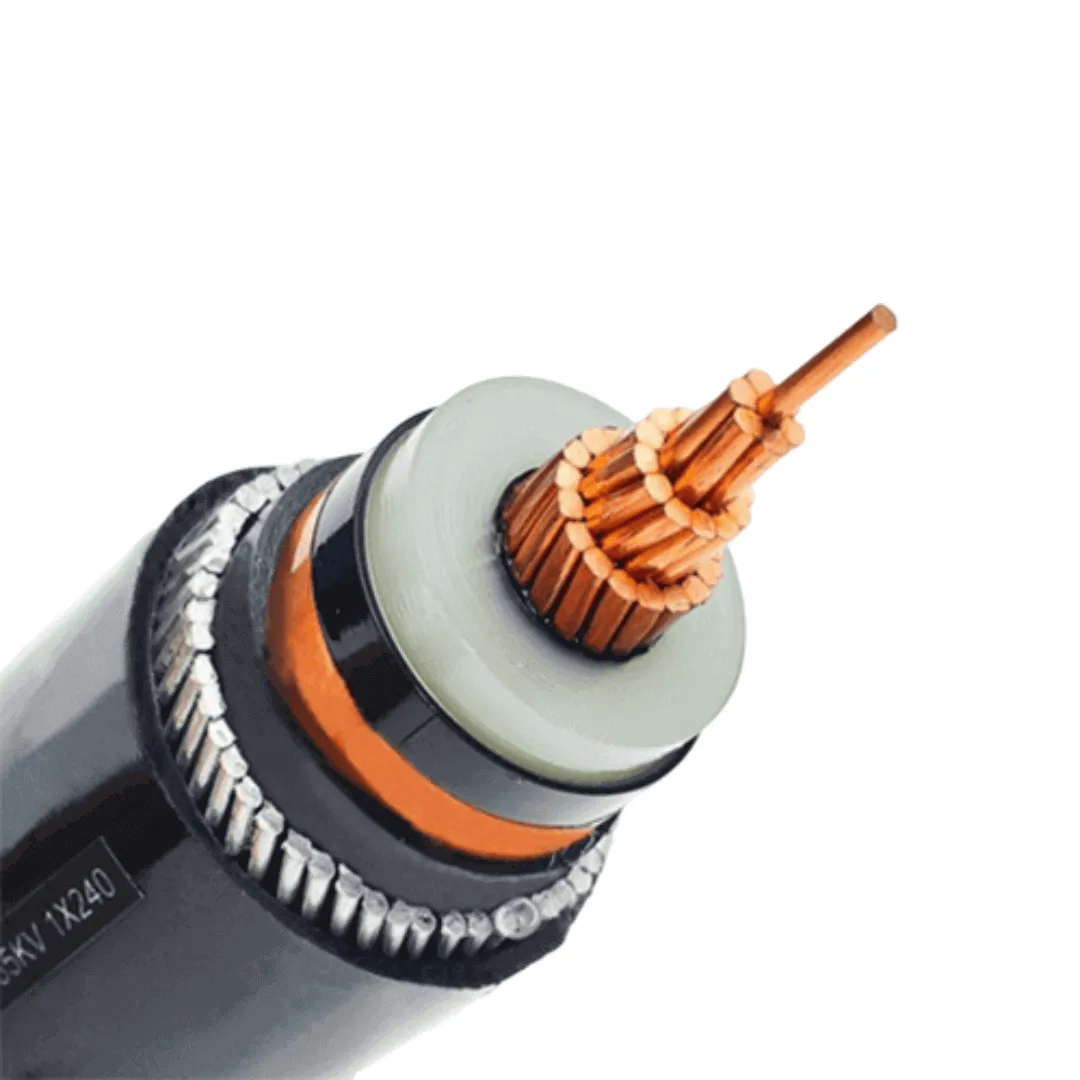
The oversheath is the last layer applied and the first one blamed. Confirming it in isolation is not much use, because the layers beneath it decide what the sheath is protecting and how the cable behaves when the sheath is breached. A 33kV cable to IEC 60502-2 runs, from the centre outwards:
| Layer | What to confirm alongside the sheath |
|---|---|
| Conductor | Copper or aluminium, stranded class to IEC 60228 |
| Conductor screen | Extruded semi-conductive, bonded to insulation |
| XLPE insulation | Nominal thickness for 18/30kV or 19/33kV rating |
| Insulation screen | Extruded semi-conductive, strippable or bonded as specified |
| Metallic screen | Copper wire or copper tape, cross-section sized for the earth fault rating |
| Bedding / separator | Present where armour is applied |
| Armour (if specified) | Aluminium wire on single-core, steel wire on three-core |
| MDPE oversheath | Material, thickness, marking — the subject of this guide |
Four of these interact directly with the sheath decision:
- Metallic screen cross-section. The screen carries the earth fault current, and its sizing is set by the network's fault level and clearing time, not by the cable size. Get this wrong and no sheath specification saves the circuit.
- Armour type on single-core. Aluminium wire armour is used on single-core 33kV rather than steel, to avoid magnetic losses. If a quotation offers steel wire armour on single-core, question it before you question the sheath.
- Bedding under the armour. A thin or missing bedding layer lets armour wires press into the insulation screen during bending. The damage shows up as a sheath complaint on site.
- Semi-conductive screen bonding. Whether the insulation screen is strippable or bonded changes how your jointers work, and it is worth fixing in the specification at the same time as the sheath.
If you are specifying the whole cable rather than only the sheath, the constructions and screen options we build are set out on our medium voltage XLPE power cable range page.
The Test Report: Five Sheath Items and Which Pages They Sit On
A routine test report arrives with every drum, and most buyers file it without reading it. The sheath section is short, and these five items are the ones worth finding before the container is released.
| # | Test | What it proves | Where it appears |
|---|---|---|---|
| 1 | Sheath thickness measurement | The nominal figure was actually built, and no point fell below the minimum | Dimensional page, usually alongside insulation thickness |
| 2 | Tensile strength and elongation at break | The compound is what was ordered and was not over-processed during extrusion | Material properties page |
| 3 | Thermal ageing on sheath samples | The compound will not embrittle in service at operating temperature | Material properties page, after-ageing values shown next to before |
| 4 | Spark test (continuity of the sheath) | No pinholes or gaps along the length — a manufacturing check, not a sample check | Routine test page, pass/fail per drum |
| 5 | Sheath integrity test where the specification calls for one | The sheath is free of the defects a voltage or immersion test would find | Electrical page |
Two reading habits that catch most problems:
Check that item 3 shows before and after values, not just one column. Thermal ageing is only meaningful as a comparison: the percentage retained after ageing is the number that matters. A report showing a single post-ageing figure with no baseline is not telling you anything.
Check that item 4 is reported per drum, not per batch. The spark test runs continuously on the line as the sheath is extruded, so a per-drum result is available and should be there. One pass/fail covering an entire order means it was recorded at the wrong level.
One caution on report scope. Routine tests are done on every production length and belong in your file. Type tests are done once to qualify a design and are not repeated per order, so a report labelled as type test evidence is not proof about your drums specifically. Ask which category each page belongs to if the report does not say. The certificates and inspection documents we can issue against an order are listed on our routine test reports and certificates page.
Third-Party Inspection: When to Book It and What to Point It At

Inspection is only useful if it happens while the cable is still in the factory. Once drums are on a vessel, a finding is a claim rather than a correction. The sequence that works:
- Name the inspection in the purchase order, including who pays and what happens if the batch fails. An inspection clause added after production has started is a negotiation, not a right.
- Book the inspector for after production, before packing. At that point drums are complete but still accessible, and cable ends can be cut for measurement without disturbing packing.
- Give the inspector a written scope, not a general instruction. "Witness testing" produces a report that says testing was witnessed. A scope naming the five items above produces numbers you can act on.
- Ask for measurement values in the report, not conclusions. "Sheath thickness compliant" is unverifiable. A row of actual millimetre readings taken at several points around the circumference, identified by drum number, is checkable against your specification.
- Decide the sampling rate in advance. Every drum, or a stated percentage. If it is a percentage, say who picks which drums — the inspector, not the factory.
A reasonable scope for a 33kV MDPE order is: sheath thickness on a cut ring, visual check of extruded marking and metre marking continuity, drum and nameplate details against the packing list, spark test records reviewed for the specific drums, and the routine test report cross-checked against drum numbers. That is a half-day for a normal order.
On our side, third-party inspection is routine rather than exceptional — several of our export orders have shipped after SGS inspection, and we treat the inspector's scope as part of the order documentation. What we will not do is claim an approval we do not hold, so if your specification calls for a particular certification body, ask us before the order rather than after.
What Direct Burial Actually Does to the Sheath
The sheath meets its worst moment during installation, not during service. Three limits decide whether it arrives intact, and all three belong in the installation method statement rather than in the cable specification.
- Pulling tension. Tension is limited by the conductor, but the sheath is what takes the friction against the duct wall. Long pulls with several bends multiply the sideways load at each bend. Where a pull is marginal, the answer is an intermediate pulling pit, not a heavier winch.
- Minimum bending radius. Expressed as a multiple of overall cable diameter, and tighter for single-core 33kV than most crews expect. Bending below the limit stresses the sheath at the outer surface and presses the armour into the bedding on the inner surface. The damage is often invisible from outside.
- Low-temperature handling. Polyethylene stiffens as temperature falls. A sheath that pulls cleanly in warm weather can crack at the outer bend surface if the drum has been sitting in cold conditions. Where installation happens in cold weather, condition the drum before pulling.
Two further points that come up on hot-climate sites. Drums stored in direct sun reach surface temperatures well above ambient, which is why carbon black content in the compound is worth specifying rather than assuming. And backfill matters as much as the sheath: sharp stone against a buried cable defeats any oversheath specification, which is why sand surround and a marker tape or tile above the cable are standard practice in most utility documents.
Full trench detail, bedding, depth and duct practice sit outside the scope of a sheath guide. Our direct-burial installation guide covers those.
Marking and Metre Marking: Your Evidence at Goods-In
Marking is the cheapest clause in the specification and the one that settles disputes. Four items to require:
| Item | What to require | What it gives you |
|---|---|---|
| Manufacturer identification | Extruded into the sheath, repeated at fixed intervals | Proof of origin without relying on the drum label |
| Voltage rating and construction | Extruded, for example 19/33kV and core arrangement | Stops the wrong drum going into the wrong circuit |
| Sequential metre marking | Continuous, restarting per drum, direction stated | Locates a fault or a damaged section by number |
| Drum nameplate and packing list | Drum number, length, gross and net weight, cable ends sealed | Reconciles what shipped against what was ordered |
Extruded marking is embossed into the sheath as it leaves the extruder, so it survives duct pulls. Surface printing can abrade away exactly when you need it. Specify extruded, and check it at goods-in rather than after installation.
One detail worth writing into the order: state that metre marking must run in a known direction relative to the drum, and that both cable ends must be sealed before shipment. Unsealed ends admit moisture during a sea crossing, and moisture at the end of a 33kV cable is a cut-back, not a wipe-down.
How We Build and Check MDPE Oversheaths
We extrude MDPE oversheaths on our own lines at our cable factory in Xinxiang, Henan, on medium voltage constructions to IEC 60502-2 and GB/T 12706.2/12706.3. What that means for a buyer, stated as things you can hold us to:
- Compound is bought to a stated density class, not to "PE" as a generic. If your specification names a density band or a carbon black content, it goes on the works order rather than being left to the line.
- Thickness is recorded per drum, not per batch, and the readings go into the routine test report that ships with the cable.
- Marking is extruded, with sequential metre marking available on request. Say so at enquiry stage and it is priced in rather than added later.
- Spark test runs continuously as the sheath is extruded, with per-drum records.
- Third-party inspection is normal for us. Several of our export orders have shipped following SGS inspection, and we treat the inspector's written scope as part of the order file.
What we do not claim: we do not hold ourselves out as having approvals we have not been granted, and we do not quote partial discharge figures tighter than the IEC 60502-2 limit as a house standard. Every drum gets a routine partial discharge test against the IEC limit with a report per drum. If your own specification is stricter than the standard, write it into the order and we will confirm before accepting rather than after.
On quantities and timing, repeated here because it is the question that follows every technical discussion: production 10-15 days, MOQ 500-1,000 metres per specification for standard constructions, 2,000-5,000 metres per specification for custom ones, sea freight on top depending on destination port. Send the cross-sections, the voltage rating, the screen requirement and the sheath lines from the table earlier in this guide, and the quotation comes back against those rather than against assumptions.
FAQ
What is 33kV MDPE cable?
A 33kV power cable whose outer protective layer is medium-density polyethylene rather than PVC. The MDPE only describes the oversheath — the conductor, XLPE insulation, semi-conductive screens and metallic screen underneath are unchanged. It is specified where the cable is buried or pulled through ducts and moisture resistance matters more than PVC's lower cost.
Is 11kV MDPE cable specified differently from 33kV?
The sheath material and the tests are the same. What changes is thickness, because nominal sheath thickness follows overall cable diameter, and 33kV constructions are larger than 11kV ones at the same conductor size. So an 11kV MDPE cable will carry a thinner nominal sheath than a 33kV cable of comparable cross-section, and both can be fully compliant. Always take the nominal figure per cross-section from the datasheet rather than carrying one number across voltage levels.
MDPE or PVC oversheath — which should I specify?
Decide from the route. Buried or in ducts, in wet or hot ground, on long pulls: MDPE, for its low water absorption and better abrasion resistance. In air, on trays, dry indoor routes, or where easy stripping matters more: PVC remains a legitimate and cheaper choice.
What sheath thickness should I ask for?
Ask for two numbers rather than one: the nominal thickness per cross-section from the approved datasheet, and a statement that no individual measured point will fall below the IEC 60502-2 minimum for that nominal. A nominal figure on its own is not enforceable, because extrusion always varies around it.
Does IEC 60502-2 cover the oversheath?
Yes. It defines the permitted sheath types including polyethylene, sets thickness requirements including how the minimum at any point is derived from the nominal, and specifies the sheath tests — tensile and elongation, thermal ageing, and the continuity spark test on the production line.
Why is HDPE not simply better than MDPE?
HDPE does resist abrasion better, which helps on long duct pulls with many bends. The trade is stiffness: it is harder to handle on site and harder for jointers to strip. On most utility distribution routes MDPE is the better balance, which is why it appears in more specifications.
Should the marking be extruded or printed?
Extruded. Embossed marking survives being dragged along a duct wall; surface printing can abrade off at exactly the point you later need to identify. Extruded marking plus sequential metre marking is what lets you locate a damaged section by number instead of arguing about cause.
When should third-party inspection happen?
After production, before packing. At that stage drums are complete but cable ends are still accessible for cutting a ring to measure sheath thickness. Name the inspection in the purchase order, give the inspector a written scope listing the specific checks, and ask for measured values in the report rather than a compliance statement.
What should the test report show for the sheath?
Five items: thickness measurements, tensile strength and elongation at break, thermal ageing with both before and after values, spark test results recorded per drum, and any sheath integrity test your specification calls up. Check that ageing shows a baseline and that the spark test is per drum, not per batch.
What are your MOQ and lead time for MDPE-sheathed MV cable?
Production is 10-15 days. MOQ is 500-1,000 metres per specification for standard constructions and 2,000-5,000 metres per specification for custom ones - the threshold comes from stranding and extrusion changeover time, not tonnage. Sea freight is additional and depends on the destination port. If your quantity is near the threshold, tell us and we will look at it rather than declining the enquiry.
For a 33kV MDPE cable quotation, send your cross-sections, route conditions, sheath specification and delivery port so the datasheet and price match your project.