Key Takeaway
Why there is no honest fixed 100m price for 2.5mm twin and earth cable in South Africa, and how contractors and importers compare bulk RFQ quotes to landed cost.
Short Answer: Why There Is No Single Honest 100m Price
If you search for a 2.5 twin and earth cable 100m price, you will find retail coil prices that move with copper, with the shop and with the week. None of them is a price you can put into a bulk order, a tender or an import plan. A 100m price only means something once you know exactly what is inside the coil, who is selling it, and where the price stops.
Two 100m coils labelled "2.5mm twin and earth" can differ in at least five ways that change cost: the size of the earth conductor (often called the CPC, circuit protective conductor), how much copper is really in the conductors, whether the cores are solid or stranded, what the sheath is made of, and which standard the cable is built and marked to. A factory quote then adds three more variables: quantity, packaging and the Incoterm.
So before you compare any price, lock these points in writing:
- Construction: 2 × 2.5 mm² insulated conductors plus an earth conductor, flat, under one sheath. State the earth size and whether it is bare or insulated.
- Conductor: copper, solid or stranded, with the maximum conductor resistance you expect at 20 °C.
- Insulation and sheath: PVC, or an LSZH sheath if your project requires it.
- Standard and marking: the standard named in your specification, and the print you need on the sheath.
- Length and packaging: 100m coils, or longer coils or drums for bulk supply.
- Commercial basis: quantity per size, Incoterm (EXW, FOB or CIF), destination port and quote validity.
This guide is for electrical contractors, distributors, project buyers and importers in South Africa and Southern Africa who are pricing bulk quantities. If you need a single coil for one job, a local wholesaler is the right place to buy. If you are pricing many coils, several sizes or a container, the rest of this guide shows how to get quotes you can actually compare.
For the product itself, including models, core options and materials, see our twin and earth cable product page.
What "2.5mm Twin and Earth" Means on a Quote
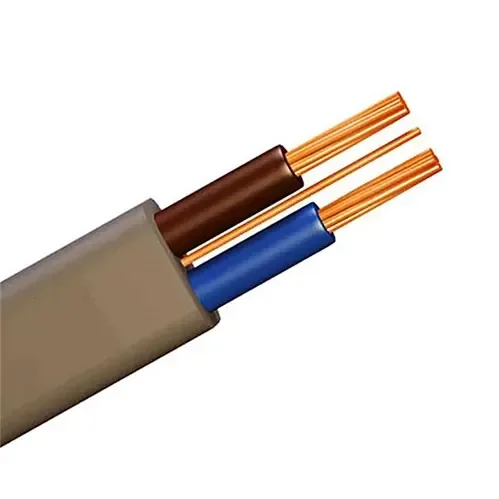
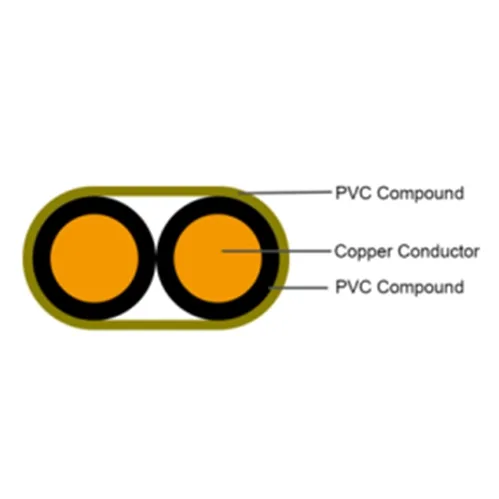
"Twin and earth" is a flat sheathed cable with two insulated circuit conductors (live and neutral) and one earth conductor laid side by side. It is used for fixed wiring of lighting and socket circuits in houses, flats and small commercial buildings, where local wiring rules allow a sheathed cable to be clipped or run in walls without conduit.
On a drawing or a BOQ you will see it written several ways: "2.5mm T&E", "2 × 2.5 mm² + E", "2C + E 2.5", or "2+1 core 2.5 mm²". All of these describe the same idea, but none of them fully defines the cable. The missing piece is usually the earth conductor.
The earth conductor (CPC) is a cost line
In many twin and earth designs the earth conductor is smaller than the circuit conductors. In the UK convention under BS 6004 (the 6242Y type), for example, a 2.5 mm² twin and earth cable carries a 1.5 mm² CPC. Other specifications call for a different earth size, an insulated earth core instead of a bare one, or a full-size earth. Each of these changes the copper weight per 100m, and copper is the largest cost item in the cable.
If one supplier quotes 2 × 2.5 mm² + 1.5 mm² bare earth and another quotes 2 × 2.5 mm² + 2.5 mm² insulated earth, the second quote will cost more, and both suppliers can call it "2.5mm twin and earth". Write the earth size and type into the RFQ, and ask each supplier to repeat it in their quote.
100m coil and bulk drum are different products to price
A 100m coil is a packaging format. In bulk supply the same cable can be packed as 100m coils, other agreed coil lengths, or longer lengths on drums. Packing in 100m coils uses more labour, labels and cartons per metre than packing on drums. When you compare a retail 100m price with a factory price, or one factory with another, make sure both prices are for the same packed length.
The simplest rule: compare price per metre for the same construction, the same packaging and the same delivery point. A price per 100m coil is fine as a display unit, as long as every quote uses it the same way.
Huanghe Models: BVVB, RVVB and BLVVB
Huanghe Cable Group makes flat twin and earth cable under the Chinese model names BVVB, RVVB and BLVVB. These names describe construction, not a South African approval:
| Model | Conductor | Flat constructions in the factory range | Notes for a South African RFQ |
|---|---|---|---|
| BVVB | Solid copper | 2 core, 2+1 (twin and earth), 3, 4 and 5 core | Closest match when the specification calls for solid copper conductors |
| RVVB | Stranded or flexible copper | 2 core, 2+1, 3, 4 and 5 core | Easier to bend; confirm the conductor class your specification requires |
| BLVVB | Solid aluminium | 2 core | Aluminium; not a twin and earth (2+1) design in our range |
All three use PVC insulation and a PVC sheath, with an LSZH sheath available as an option. Rated voltages in the factory range are 300/500 V, 450/750 V and 0.6/1 kV. The earth core can be bare copper or insulated copper. The factory size family includes 1.5, 2.5, 4 and 6 mm², but a size being in the family range does not mean it is in stock or certified for your market. Construction details for your order are confirmed on an order-specific datasheet.
One point needs care. BVVB is a Chinese market model name. The model name on its own does not prove compliance with SANS, BS or IEC standards, and it is not automatically the same product as a cable built to SANS 1507-2 or BS 6004, even when the size reads the same. The standard and the documents have to be locked on the order. If your project specification names a South African or British standard, put that standard in the RFQ and ask the supplier to confirm, in writing, whether they will build to it and what documents they can provide. We cover this in the compliance section below.
What Drives a Bulk 2.5mm Twin and Earth Cable Quote
A factory price for flat twin and earth cable is built from materials, processing and the commercial terms around them. Knowing which item moves the number helps you spot which quote has left something out.
Copper in the circuit conductors and the CPC
Copper is usually the largest single cost in a 2.5 mm² twin and earth cable. Copper weight depends on three things: the nominal cross-section of the two circuit conductors, the cross-section of the earth conductor, and how close the real conductor is to its nominal size.
The last point is where low quotes often come from. A cable can be marked 2.5 mm² and still use less copper than a full-size conductor. The way to check this is not to weigh coils on site. It is to name a maximum DC conductor resistance at 20 °C in the RFQ, taken from the conductor standard your specification uses (IEC 60228 is the common reference), and ask for a conductor resistance result in the routine test record for your order. Resistance is what the copper does in service; it is also the number that shows whether the copper is really there.
Solid or stranded conductors
Solid copper (BVVB) and stranded copper (RVVB) cost differently to make because stranding adds a process step. Specifications also differ: many fixed-wiring specifications for 2.5 mm² expect a solid or a specific stranded conductor class. Do not let a supplier switch between the two without stating it. State the conductor type and class in the RFQ.
Insulation and sheath compound
Standard construction uses PVC insulation and a PVC sheath, rated 70 °C continuous in our range. An LSZH (low smoke zero halogen) sheath is available as an option and costs more than PVC. Flame retardant and anti-termite versions are also produced on request. If one supplier quotes PVC and another quotes LSZH, the quotes are not comparable.
Insulation and sheath thickness matter too. Thinner walls save compound and lower the price, but the thickness has to meet the standard on your order. Ask for nominal insulation and sheath thickness and overall dimensions on the datasheet.
Standard, marking and core colours
Building to a named standard with specific core colours, sheath colour and printed marking can change the compound and the production setup. Core colours for live and neutral, the colour of the earth sleeving where used, and the sheath colour should all be written into the RFQ. So should the text you need printed on the sheath, such as size, voltage, standard, manufacturer name and metre marking.
Coil length and packaging
Packing into 100m coils with shrink wrap, labels and cartons costs more per metre than winding long lengths on a drum. Export packaging, palletising and any branded or private-label packaging add to that. If you need 100m coils for resale and longer lengths for site work, ask for separate prices for each.
Quantity per size
Factory cost per metre falls as the production run per size gets longer, because changing a line between sizes takes time and material. A quote for 2.5 mm² only and a quote for a mixed order of 1.5, 2.5, 4 and 6 mm² at small quantities each will not have the same unit price. The minimum quantity per size is confirmed after RFQ review against your exact construction.
Copper price basis and quote validity
Because copper moves, a factory quote for copper cable is valid for a limited time. Ask each supplier to state how long the price holds and whether it is linked to a copper reference price on a stated date. Two quotes issued a few weeks apart can differ only because copper moved. Comparing them as if they were issued on the same day is misleading.
Payment terms and currency
Deposit percentage, balance terms and currency (USD or another currency) affect what you pay in rand once exchange rate movement is included. Keep these fixed across suppliers when you compare.
Pricing 1.5, 2.5, 4 and 6 mm² in One RFQ
Most South African wiring jobs and distributor orders do not use 2.5 mm² alone. Lighting circuits, socket circuits and heavier loads such as stoves or geysers often appear in the same BOQ in different sizes. Putting them in one RFQ is usually cheaper than buying each size separately, but only if the RFQ is built so that each line can be compared.
Use one line per size, and keep every other attribute the same unless your specification says otherwise:
| Line | Construction to state | Earth to state | What to ask the supplier to repeat |
|---|---|---|---|
| 1.5 mm² | 2 × 1.5 mm² + E, flat | Earth size, bare or insulated | Conductor type, max conductor resistance, sheath, coil length |
| 2.5 mm² | 2 × 2.5 mm² + E, flat | Earth size, bare or insulated | Same as above |
| 4 mm² | 2 × 4 mm² + E, flat | Earth size, bare or insulated | Same as above |
| 6 mm² | 2 × 6 mm² + E, flat | Earth size, bare or insulated | Same as above |
A few practical points on the size mix:
- Ask for a price per metre for each size, not a single blended price for the whole order. Blended prices hide which size is cheap and which is not.
- Keep the quantity per size realistic. If 2.5 mm² is 70% of your order, say so. The factory plans production runs per size, and the split affects the unit price.
- Ask for a 1.5 mm², 4 mm² and 6 mm² twin and earth cable price on the same validity date and copper basis as 2.5 mm². Otherwise the comparison drifts.
- The choice of size for each circuit is a design decision. Current-carrying capacity depends on the installation method, grouping, ambient temperature, protective device and the wiring code your project follows. Your electrical engineer or a registered electrical contractor sets the size per circuit, not the cable supplier. We do not give current ratings for twin and earth sizes in this guide for that reason.
Retail 100m Coil Price vs Factory Bulk Quote
The prices you see from South African wholesalers and hardware chains for a 100m roll are a different kind of number from a factory quote. Both are valid, but they include different things.
A local retail or trade price for a 100m coil already includes:
- The importer's or local manufacturer's cost of the cable
- Freight, insurance, clearing and import charges where the cable is imported
- Inland transport to the warehouse and store
- Stock holding, local compliance work and after-sales support
- Wholesaler and retailer margin
- VAT, for consumer prices
A factory quote from China covers the cable and the agreed packaging up to the Incoterm point, and nothing after it. That is why a factory price per metre looks lower than the retail price per metre. The fair comparison is your landed cost per metre, after every charge on your side, against what you pay a local supplier today.
When does importing make sense? Usually when quantities are large enough to fill a meaningful part of a container, when you can wait for production plus shipping, and when you or your clearing agent can handle the import and compliance work. For a few coils needed this week, the local channel is almost always the better choice.
This also explains why we do not publish a rand per 100m figure. A number on a web page cannot reflect the copper price on the day you order, your size mix, your packaging or your port. Any figure we printed would either be out of date or not describe your order.
From EXW, FOB or CIF to Landed Cost in South Africa
Incoterms define where the seller's responsibility for cost and risk ends. The current rules are Incoterms® 2020, published by the International Chamber of Commerce (ICC). The three you will meet most often in a cable quote are:
- EXW (Ex Works): the price covers the goods at the factory. You arrange and pay for everything from loading onward.
- FOB (Free On Board): the seller delivers the goods on board the vessel at the named port of shipment in China. Ocean freight and everything after loading is yours.
- CIF (Cost, Insurance and Freight): the seller pays freight and minimum insurance to the named destination port, for example Durban. Risk passes when the goods are on board in China. Unloading, import clearance and onward delivery are yours.
Normalise every quote to the same point
Before comparing suppliers, convert every quote to the same Incoterm and the same port. If one supplier quotes FOB Shanghai and another quotes CIF Durban, you either add freight and insurance to the FOB quote or ask the first supplier for a CIF price. Comparing an FOB number with a CIF number makes the FOB supplier look cheaper when it may not be.
A simple normalisation worksheet:
| Step | Item | Who confirms it |
|---|---|---|
| 1 | Cable price per metre at the quoted Incoterm, per size | Supplier |
| 2 | Packaging included, coil or drum length, carton and pallet details | Supplier |
| 3 | Freight to the South African port, if not included | Freight forwarder or supplier |
| 4 | Marine insurance, if not included or if you want more than the CIF minimum | Insurer or forwarder |
| 5 | Destination port charges and handling | Forwarder or clearing agent |
| 6 | Customs duty, if any, on the tariff heading used | Clearing agent, against the SARS tariff |
| 7 | Import VAT and its calculation basis | Clearing agent, against SARS rules |
| 8 | Any compliance cost (testing, inspection, approvals) | Your engineer, regulator or test house |
| 9 | Inland transport to warehouse or site | Transport provider |
| 10 | Finance cost and exchange-rate allowance | Your own finance team |
Divide the total by the metres received per size, and you have a landed cost per metre you can compare with local prices.
Duty and VAT: confirm, do not assume
We do not give a duty rate or VAT calculation in this guide. The tariff heading for insulated electric cable depends on the exact description, voltage and construction, and rates, rebates and trade-agreement treatment can change. Customs duty and import VAT in South Africa are administered by the South African Revenue Service (SARS). Ask your licensed clearing agent to confirm the tariff heading, duty and VAT for your exact cable description in writing before you confirm the order, and make sure the description on the commercial invoice matches. Your contract with the supplier and your agent's advice are the reference, not a figure from a supplier website.
Supplier Quote Comparison Table
Once quotes come back, put them side by side in one table before you look at the price column. If a cell is empty, the quote is incomplete, and the price on it is not yet comparable.
| Check | Supplier A | Supplier B | Supplier C |
|---|---|---|---|
| Construction (2 × 2.5 mm² + earth, flat) | |||
| Earth size and type (bare / insulated) | |||
| Conductor (solid / stranded, class) | |||
| Max conductor resistance at 20 °C stated | |||
| Insulation and sheath (PVC / LSZH) | |||
| Insulation and sheath thickness stated | |||
| Standard the cable is built to | |||
| Core colours, sheath colour, print text | |||
| Coil length and packaging | |||
| Quantity per size | |||
| Incoterm and named port | |||
| Price per metre per size | |||
| Copper basis and quote validity | |||
| Payment terms and currency | |||
| Documents offered (datasheet, test record, certificates) | |||
| Production time stated for this order |
Red flags in low twin and earth quotes
A low price is not a problem in itself. A low price with missing information usually is. Look harder when you see:
- No earth size, or an earth size that changes between the quote and the datasheet.
- No maximum conductor resistance, or a refusal to state it. This is the most common place where copper content is reduced.
- "Copper" without saying solid or stranded, or a conductor described only as "CCA" or "copper clad" in small print. Copper clad aluminium is not copper and should not be quoted against a copper specification.
- No standard named, or a standard named without the supplier confirming it will build to it.
- A certificate offered that does not list the model, size or voltage you are buying.
- A quote valid for a long period with no copper basis, which usually means the price will be revised later.
- Packed length stated as "approx. 100m" without a tolerance or a metre marking.
- A price far below other complete quotes with no explanation of which item is cheaper.
When you see one of these, ask the question in writing. A supplier who builds cable properly can usually answer quickly.
South Africa Compliance and Document Checklist
This is the section where buyers most often confuse three separate ideas: a standard that applies to a product, a requirement set by a regulator or a project, and a certificate held by a manufacturer. They are not the same thing.
- A standard describes how a cable is built and tested. In South Africa, the SANS 1507 series covers electric cables with extruded solid dielectric insulation for fixed installations; Part 2 (SANS 1507-2) covers wiring cables, the part relevant to flat multicore fixed wiring such as twin and earth. A cable can be built to a standard without being certified to it.
- A requirement is what your regulator, utility, municipality, client or engineer says the cable must meet. Low-voltage fixed-installation cables in South Africa fall under a compulsory specification, VC 8075, administered by the National Regulator for Compulsory Specifications (NRCS). Products under a compulsory specification need a Letter of Authority (LOA) from the NRCS before they are sold. How VC 8075 applies to a specific cable product and shipment, and who holds the LOA, is something your importer, clearing agent and engineer should confirm with the NRCS.
- A certificate is a document issued by a certification body for a defined product scope, from a defined factory, for a defined period. It covers only what it lists.
To be clear about our position: Huanghe does not claim SANS product certification or South African approval for its twin and earth cable. Our flat cable is built to the standard on your order, and the documents we can provide for that order are confirmed before production. If your project needs a cable built to SANS 1507-2 or BS 6004, or needs an NRCS LOA or other local approval, tell us at RFQ stage. We will tell you plainly whether we can build to it and what documents we can and cannot supply. Your engineer or regulator decides whether that is enough.
Documents to ask any supplier for, from us or anyone else:
- An order-specific datasheet with construction, dimensions, conductor resistance and materials
- Routine test records for the production batch, as defined by the standard on your order
- Any product certificate, with the model, size range, voltage and validity shown on it
- The factory's management-system certificates (such as ISO 9001), understood as factory system certificates, not product certificates
- Packing list and commercial invoice with a cable description your clearing agent has agreed
Our certificates page lists the documents we hold. Use it to check scope: read the model, size range, voltage and validity on each certificate, and compare them with the line items in your RFQ. If a certificate does not list the cable you are buying, it does not cover it.
Copy-Ready RFQ for Bulk Twin and Earth Cable
Copy this into an email or a document, fill in the brackets, and send the same version to every supplier you want to compare.
Subject: RFQ – Flat twin and earth cable, [quantity] m, [destination port], South Africa

Company: [name, city, country]
Contact: [name, email, phone]
Project or use: [house wiring / distribution stock / project name]

1. Product
   Flat twin and earth cable, 2 cores + earth, PVC insulated, [PVC / LSZH] sheathed
   Conductor: copper, [solid / stranded], class [x] to [IEC 60228 or standard on spec]
   Standard to build to: [standard named in our specification]
   Rated voltage: [300/500 V / other]

2. Lines (price per metre per line, please)
   Line 1: 2 x 1.5 mm2 + [x] mm2 [bare / insulated] earth, [quantity] m
   Line 2: 2 x 2.5 mm2 + [x] mm2 [bare / insulated] earth, [quantity] m
   Line 3: 2 x 4 mm2 + [x] mm2 [bare / insulated] earth, [quantity] m
   Line 4: 2 x 6 mm2 + [x] mm2 [bare / insulated] earth, [quantity] m

3. Requirements
   Max DC conductor resistance at 20 C: state per size
   Insulation and sheath nominal thickness and overall dimensions: state per size
   Core colours: [live / neutral]; earth sleeving: [if required]
   Sheath colour: [colour]
   Sheath print: [size, voltage, standard, maker, metre marking]

4. Packaging
   [100 m coils, shrink wrapped, cartons, pallets] or [drums of x m]
   Labels: [plain / our brand]

5. Commercial
   Incoterm: [FOB China port / CIF Durban / other]
   Price validity and copper basis: please state
   Payment terms: [proposed]
   Production time for this order: please state

6. Documents required
   Order-specific datasheet before production
   Routine test records for the batch
   List of any certificates that cover these exact lines
If you send this to us, we review the construction and come back with questions where the specification is unclear, then a quote per line tied to a datasheet. Minimum quantity per size is confirmed after RFQ review against your exact construction and packaging.
What Huanghe Can Supply, and What We Do Not Claim
Huanghe Cable Group is a Chinese cable manufacturer. China Cable Factory is its English-language site for overseas buyers. For flat twin and earth cable, here is what we can offer and where the limits are.
What we make:
- Flat sheathed cable as BVVB (solid copper), RVVB (stranded or flexible copper) and BLVVB (solid aluminium, 2 core)
- 2 core, 2+1 (twin and earth), 3, 4 and 5 core flat constructions in copper
- Rated voltages of 300/500 V, 450/750 V and 0.6/1 kV
- PVC insulation and PVC sheath, with an LSZH sheath as an option; flame retardant and anti-termite versions on request
- Earth core as bare copper or insulated copper
- Cross-sections from the factory size family, including 1.5, 2.5, 4 and 6 mm²
- Packing in coils or on drums at the length you specify, with sheath print agreed on the order
What we do not claim:
- We do not claim SANS product certification or any South African approval for twin and earth cable.
- We do not state that any size is in stock. Our quotes are for production to your specification.
- We do not publish a fixed minimum order or a fixed delivery time for this cable. Both depend on construction, size mix and packaging and are confirmed after RFQ review.
- We do not publish prices. Each quote is tied to the copper basis on the quote date and to your exact specification.
If you want to see how and where the cable is made before you order, our factory page shows the production setup. The full product family sits in our electrical wire range, alongside single-core building wire and flexible wire, if your BOQ needs those too.
Get a Bulk Quote You Can Compare
A 100m price for 2.5mm twin and earth cable is only useful when it describes a defined cable, a defined pack and a defined delivery point. Lock the construction (including the earth), name the standard, ask for conductor resistance, keep the Incoterm and validity the same for every supplier, and add your own clearing and inland costs to reach landed cost.
When your sizes and quantities are ready, send your twin and earth specification for a quote. Paste the RFQ template above or attach your BOQ, and include the earth size, coil length, Incoterm and port. We reply with questions where the specification needs confirming, then a per-line quote tied to an order-specific datasheet.
FAQ
What is the price of 2.5 twin and earth cable per 100m in South Africa?
There is no fixed bulk price. A 100m roll price from a local wholesaler includes import, stock and margin costs, while a factory quote covers only the cable and packaging up to the Incoterm point. For a bulk order, the price depends on the copper basis on the quote date, the earth size, conductor type, sheath material, coil length, quantity per size and Incoterm. Compare quotes as price per metre for the same construction and delivery point, then add your own import and inland costs.
Why do two 2.5mm twin and earth quotes differ so much?
Usually because they do not describe the same cable. Earth conductor size, real copper content (shown by conductor resistance), solid or stranded conductors, PVC or LSZH sheath, coil length and Incoterm all change the price. Put every quote into one comparison table and check those items before comparing price.
What earth size comes with 2.5 mm² twin and earth cable?
It depends on the standard and specification. In the UK BS 6004 convention, a 2.5 mm² twin and earth cable has a 1.5 mm² earth conductor. Other specifications differ. State the earth size and whether it is bare or insulated in your RFQ.
Can I get 1.5, 4 and 6 mm² twin and earth cable on the same quote?
Yes. Put each size on its own line with its own quantity and ask for a price per metre per line, on the same copper basis and validity date. Which size suits each circuit is a design decision for your engineer or electrical contractor.
Is your twin and earth cable SANS certified?
No. We do not claim SANS product certification or South African approval for this cable. It is built to the standard on your order. If your project specifies SANS 1507-2, BS 6004 or another standard, or needs an NRCS LOA or other local approval, tell us at RFQ stage and we will confirm what we can build and which documents we can supply.
Do you sell single 100m coils?
Our quotes are for bulk and project quantities. For one or a few coils, a local South African wholesaler is the quicker option. We can pack bulk orders in 100m coils if that is the format you resell or install.
Should I ask for FOB or CIF Durban?
Either works if you use it consistently. FOB suits buyers with their own forwarder. CIF to Durban or another South African port makes comparison simpler if every supplier quotes the same port. In both cases, import clearance, duty, VAT and inland delivery are on your side and should be confirmed by your clearing agent.
What is the minimum order for flat twin and earth cable?
It is confirmed after RFQ review, because it depends on the construction, size mix, colours and packaging. If your quantity is small, tell us anyway and we will say whether it can be produced.
Sources
- International Chamber of Commerce (ICC), Incoterms® rules, iccwbo.org/business-solutions/incoterms-rules, checked October 2026: definitions of EXW, FOB and CIF under Incoterms® 2020.
- South African Revenue Service (SARS), Customs and Excise and the Schedules to the Customs and Excise Act, 1964, sars.gov.za, checked October 2026: authority for tariff classification, customs duty and import VAT. No rates are quoted in this guide.
- SANS 1507-2, Wiring cables: Electric cables with extruded solid dielectric insulation for fixed installations (300/500 V to 1 900/3 300 V), Part 2. Catalogue record on the SABS Standards Store, store.sabs.co.za, checked October 2026.
- National Regulator for Compulsory Specifications (NRCS), nrcs.org.za, and South African Government notices on gov.za, checked October 2026: compulsory specification VC 8075 for electric cables with extruded solid dielectric insulation for fixed installations (300/500 V to 1 900/3 300 V), and the NRCS Letter of Authority requirement for products under compulsory specifications.
- Huanghe factory product data for flat twin and earth cable (BVVB, RVVB, BLVVB): models, core options, voltages, materials and size family, as published on the Huanghe flat twin and earth cable product page.